When large language models began leaping forward in capability in 2021, Elaine Zelby knew what she needed to do: start a company to slash the wasted time and money that goes into building marketing campaigns. “I’d spent eight years leading B2B go-to-market teams, so I knew how much repetitive and painful work was involved,” she says. With generative AI on the near horizon, “I couldn’t let go of the idea that we could build a panacea for people doing the jobs I used to do.”
Zelby and two co-founders are chasing that bold dream with Tofu. The company has developed a platform that helps companies scale targeted campaigns, automatically creating a wide variety of content, personalized for each customer. “We ingest your company data to create an artificial intelligence knowledge graph, which lets us generate hundreds or thousands of hyper-personalized emails, landing pages, white papers, e-books—whatever you need,” she says. “And everything is on brand and on message, 100% of the time.”
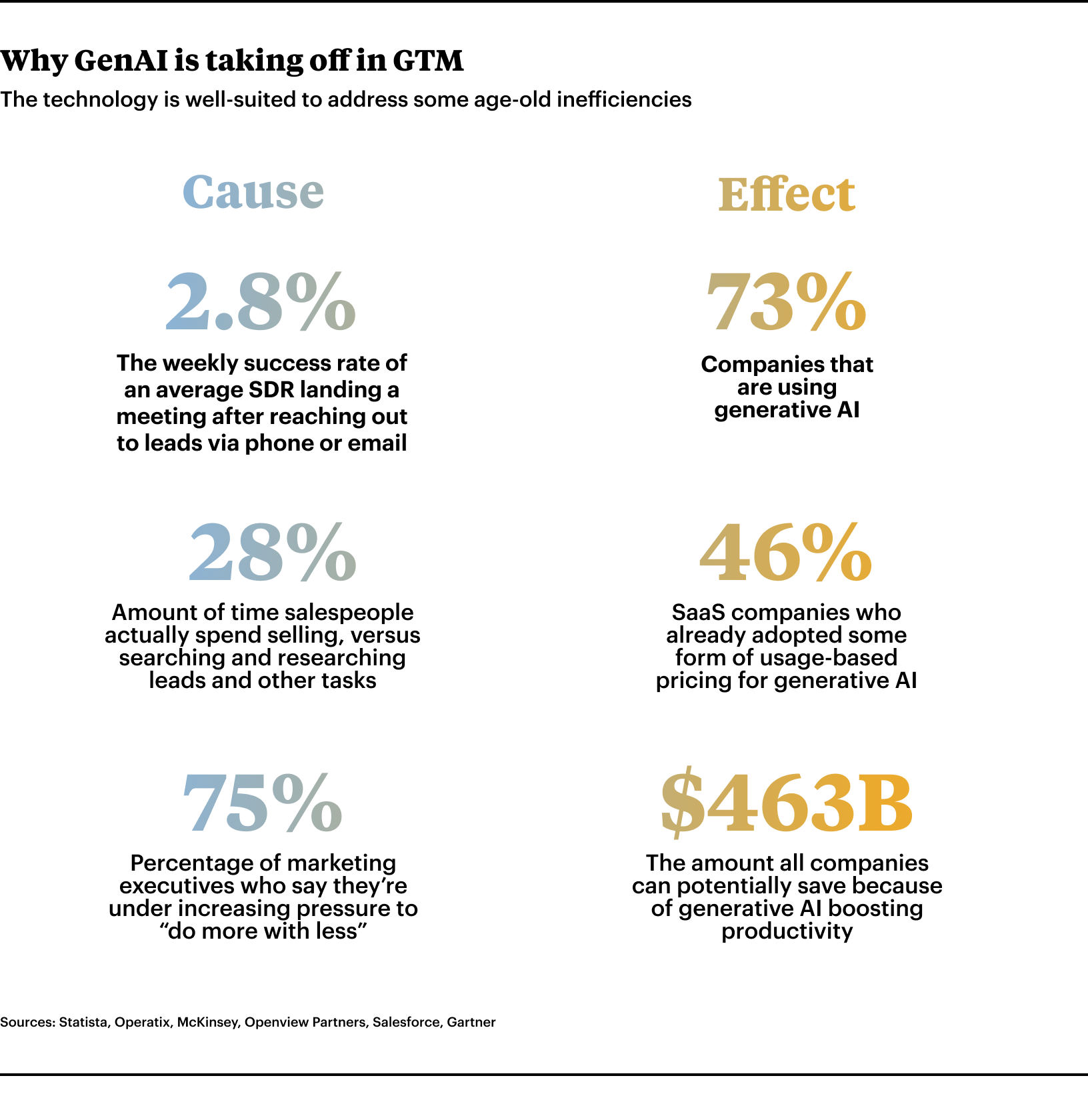
We believe in that vision as well. Even if generative AI never becomes a panacea, it will have a broad, structural impact on the three main functions that make up a go-to-market (GTM) strategy: marketing, sales, and customer service. Even as of March 2023, 73% of companies polled by Statista were using generative AI 1. Change is coming fast.
So how will tech companies need to overhaul their operations to ride the coming generative AI wave? We asked two NEA partners with deep operating and investing expertise in GTM for their views. Hilarie Koplow-McAdams, a former president of Salesforce’s sales operation, and Vanessa Larco, a veteran of Box and Twilio, share five predictions about how generative ai will change the rules of GTM.
The potential for generative AI to generate new content across marketing channels, from daily emails and slide decks to blogs and ad copy, has the marketing industry salivating. While that may become increasingly possible in the future, Larco believes that for now, the most productive use of the technology is to streamline the gathering of information given the countless hours currently spent looking at user data and usage data reports, transcripts of interviews with customers, and reading industry news.
Large language models (LLMs) are perfectly suited to handle this time-consuming work in nanoseconds, potentially saving marketing professionals five hours a week, according to a study by Salesforce. And startups such as Orby AI are developing ways to automate other mundane, time-consuming administrative processes. More efficiency gains are on the horizon, says Larco. Rather than force salespeople to record new orders in the CRM system, send it to legal for approval, and provide a Docusign signature, Orby’s software would handle these tasks behind the scenes.
All of the time saved on research and administrative processes leaves more time for a far more valuable activity: thinking. “The greatest value is in making your people more effective in the human-centered work they excel at,” says Koplow-McAdams.
Larco agrees. “Today, people probably spend 95% of their time figuring out what is happening, rather than what to do about it,” she says. “Maybe we can make 20% or 40% of their time available for high-level thinking, which is what humans are uniquely good at.”
Every sales team and organization struggles with how to do outbound sales. The usual approach is to hire young, inexperienced sales development representatives (SDRs) to make cold calls (and send cold emails, texts, and other forms of outreach). But with more enthusiasm than experience, the process is not very effective. According to Operatix, the average SDR will reach out to more than 1,400 leads a month via phone or email, all to land just a dozen meetings. Harder to calculate is how many of the other 1,388 leads were turned off by the process.
Even in these early days of generative AI, well-trained LLMs are already improving on this “spray and pray” sales strategy. They don’t misspell names and are always up to date on the industry news. What’s more, they stick to the scripts that were carefully prepared to reflect the company’s marketing messages throughout the sales cycle. “It’s often hard to get SDRs to stick to the script,” says Koplow-McAdams. “With generative AI, you can generate text or video content highly personalized to the customer that’s within a standard of quality that somebody in product marketing has blessed and without deviation. That’s huge.”
It won’t be long before companies can move beyond just text, says Larco. She says NEA is looking at one startup that can automatically personalize a marketing video by altering a speaker’s mouth movement so it appears he’s saying the recipient’s name. “It looks like I made a hundred different personalized videos, but I just made one,” Larco notes.
These technologies will give go-to-market leaders new options. Generative artificial intelligence can be used to train or assist promising young employees, or it could be used to allow startups to grow more efficiently. “The No. 1 rule for startups these days is to spend less, have fewer headcount, and fewer tools,” says Zelby. “That's the name of the game in generative AI: help your teams do more with less.”
Research firm McKinsey predicts that generative AI will give marketers a 10% productivity lift, leading to $463 billion in annual savings. But what will they do with the extra hour or so a day?
One option is to simply cut costs. Another is to crank up the amount of content you create. But Larco suggests putting the gifted hours into further refining your generative AI skills, like prompt engineering.